Showing posts with label Prostate cancer treatment in india. Show all posts

Thursday, 9 October 2014

Laser Prostate Surgery in India : Cost Estimate for Laser Prostate Surgery is $5000 US Dollars

Green Light PVP Surgery of Prostate in India

Thislasertreatment of the prostate is a new, minimally invasive surgical technique for treating Benign Prostatic Hyperplasia (BPH), or enlargement of the prostate. Greenlight HPS utilizes a specially designed laser light source and fiber optic delivery system developed by Laserscope in concert with researchers from the Mayo Clinic and other institutions around the world. The PVP procedure combines the immediate symptom relief and the dramatic flow rate improvements of the current "gold standard" procedure (called TURP or Trans-Urethral Resection of the Prostate) with minimal side effects, fast operative and recovery times, and usually no need for a catheter after surgery.

No other BPH treatment option has been shown to clinically provide such dramatic and immediate symptom relief while concurrently providing significant uroflow results and minimal, if any, side-effects. The PVP technique is a fast, outpatient treatment that will satisfy both the subjective (symptom relief) and objective (uroflowometry results) outcomes of a successful BPH treatment. Other minimally invasive BPH treatment options (such as TUMT, microwave, TUNA, thermotherapy) require compromises to be made by the patient and/or the physician. With PVP, there are no compromises, patient's symptoms are drastically reduced and flow rates are significantly improved.


The PVP (Photoselective Vaporization of the Prostate) Procedure that uses the Green Light PV laser system offers a unique and simple solution to Benign Prostatic Hypertrophy (BPH) because it combines the effectiveness of TURP, the surgical "gold standard" with the safety, comfort and ease of a minimally invasive treatment.

The PVP Procedure uses a very high powered laser to immediately vaporize and precisely remove enlarged prostate tissue. PVP (Photo-Selective Vaporization of the Prostate) is performed with the KTP laser by Laserscope (Greenlight PVP). This laser treatment of the prostate is a new, minimally invasive surgical technique for treating Benign Prostatic Hyperplasia (BPH), or enlargement of the prostate. 

Greenlight PV utilizes a specially designed laser light source and fiber optic delivery system.
The PVP procedure combines the immediate symptom relief and the dramatic flow rate improvements of the current "gold standard" procedure (called TURP or Trans-Urethral Resection of the Prostate) with minimal side effects, fast operative and recovery times, and usually no need for a catheter after surgery.

No other BPH treatment option has been shown to clinically provide such dramatic and immediate symptom relief while concurrently providing significant uroflow results and minimal, if any, side-effects. The PVP technique is a fast, outpatient treatment that will satisfy both the subjective (symptom relief) and objective (uroflowometry results) outcomes of a successful BPH treatment. Other minimally invasive BPH treatment options (such as TUMT, microwave, TUNA, thermotherapy) require compromises to be made by the patient and/or the physician. With PVP, there are no compromises, patient's symptoms are drastically reduced and flow rates are significantly improved.

The PVP procedure is performed in an outpatient setting, typically a hospital or surgical center, with average operative times normally less than 60 minutes. The GreenLight PV surgical laser system, which is used to perform the KTP laser PVP treatment, delivers laser light pulses through a specially designed fiber optic delivery device that is inserted through a standard cystoscope. The light pulses are directed towards the prostate tissue. The laser quickly vaporizes and removes the prostatic obstruction without significant bleeding.

Once the procedure is completed, patients have immediate post-operative symptom relief and dramatic improvements in symptoms, urinary flow rates, and bladder emptying.


Cost Estimate for Laser Prostate Surgery is $5000 US Dollars - Cost Estimate for above include stay in a Private Room for 4 days at the hospital, More accurate treatment cost estimates can be provided if medical reports are emailed to us or after the patient is examined by doctors after arrival at hospital in India and medical tests are done after admission.

For more information visit:          http://www.medworldindia.com     
                    
https://www.facebook.com/medworld.india

Please scan and email your medical reports  to us at care@medworldindia.com and we shall get you a Free Medical Opinion from India’s Best Doctors.

Call Us : +91-9811058159
Mail Us : care@medworldindia.com

Saturday, 13 September 2014

HIFU in India : HIFU Ultrasound Hope for Prostate Cancer Patients

HIFU Ultrasound Hope for Prostate Cancer Patients 


Soundwaves could help 95% of prostate cancer patients … without affecting sex life,”  Its story comes from a small study that looked at an experimental treatment using high-intensity focusedultrasound (HIFU) to target areas of prostate cancer in men where the disease had not spread.

Standard treatments for prostate cancer often lead to undesirable side effects, in particular erectile dysfunction and urinary incontinence. Researchers found that a year after this experimental treatment, 89% of men still had erectile function and all were still continent. Ninety-five per cent of the men showed no evidence of disease on an MRI scan.

The results of this small study look promising. Men with early (localised) prostate cancer that has not spread can often live for years without developing life-threatening symptoms, and are often faced with a difficult decision about whether or not to have conventional treatment, which can have side effects. A treatment that can target areas of cancer without damaging healthy tissue might enable more men to have treatment for prostate cancer at an early stage.

However, it’s important to point out that this is an early “proof of concept” study and that a far larger trial is required to assess both its effectiveness and safety.This was an early (prospective development) study looking at a new treatment for localised prostate cancer called high-intensity focused ultrasound (HIFU).

Prostate cancer is the most common cancer in men, yet, as the authors point out, treating localised prostate cancer is difficult since the disease often progresses slowly and may not cause any symptoms for many years. There are several standard treatments for localised prostate cancer. Some involve treating the whole prostate with radiotherapy or removing it with surgery, and these can damage surrounding healthy tissue. The more destructive treatments of the whole prostate gland lead to undesirable side effects, in particular, erection problems (affecting 30-70% of men treated) and urinary incontinence (affecting 5-20%). One alternative for men at present is to have no active treatment but to undergo regular checks. This is known as active surveillance.


The new treatment, say the authors, is less aggressive and able to target the cancer site rather than the whole organ. In this respect, it is similar to treatment for other malignancies, such as localised breast cancer (where a lumpectomy is now an alternative to mastectomy). They say that in a previous study they had used HIFU to destroy one half of the prostate where the cancer was situated. But they point out that only one in five men have disease in one half of the prostate only. Their new study looked at whether HIFU could be used for treating cancer at specific sites within the prostate.


 • No blood loss

 • Quick recovery

 • Non surgical

 • Radiation free

 • An outpatient procedure

This is most modern technique ideal for treatment of low grade prostate cancer. It involves no surgery, no radiation , good cancer control, minimal morbidity. HIFU helps to improve the quality of life after Treatment and there are some more advantages like early return of erections and good urinary control.

For more information visit:          http://www.medworldindia.com       
                    
https://www.facebook.com/medworld.india

Please scan and email your medical reports  to us at care@medworldindia.com and we shall get you a Free Medical Opinion from India’s Best Doctors.

Call Us : +91-9811058159
Mail Us : care@medworldindia.com

Saturday, 23 August 2014

Men with Prostate Cancer have many Treatment Options : Best and Advanced Treatment of Prostate Cancer in India


Prostate cancer generally affects men over 50 and is rare in younger men. It’s the most common type of cancer in men. It differs from most other cancers in the body, in that small areas of cancer within the prostate are very common and may stay dormant (inactive) for many years. Most of these cancers grow very slowly and so, particularly in elderly men, are unlikely to cause any problems. In a small proportion of men, prostate cancer can grow more quickly and in some cases may spread to other parts of the body, particularly the bones.

Symptoms of Prostate Cancer

A man with prostate cancer may not have any symptoms. Symptoms of prostate cancer are often similar to those of benign prostatic hyperplasia (BPH). Men observing the following signs and/or symptoms should see their physician for a thorough examination:
  • Urinary problems - Not being able to pass urine รข€¢ Having a hard time starting or stopping the urine flow
  • Needing to urinate often, especially at night
  • Weak flow of urine
  • Urine flow that starts and stops
  • Pain or burning during urination
  • Blood in the urine or semen
  • Frequent pain in the lower back, hips, or upper thighs If you have any of these symptoms, you should tell your doctor so that problems can be diagnosed and treated.


PDigital rectal exam (DRE) : The doctor inserts a lubricated, gloved finger into the rectum and feels the prostate through the rectal wall for lumps or abnormal areas.

Prostate-specific antigen (PSA) test:A test that measures the level of PSA in the blood. PSA is a substance made by the prostate that may be found in an increased amount in the blood of men who have prostate cancer. PSA levels may also be high in men who have an infection or inflammation of the prostate or BPH (an enlarged, but noncancerous, prostate).

Transrectal ultrasound : A procedure in which a probe that is about the size of a finger is inserted into the rectum to check the prostate. The probe is used to bounce high-energy sound waves (ultrasound) off internal tissues or organs and make echoes. Transrectal ultrasound may be used during a biopsy procedure.

Biopsy :The removal of cells or tissues so they can be viewed under a microscope by a pathologist. The pathologist will examine the biopsy sample to check for cancer cells and determine the Gleason score. The Gleason score ranges from 2-10 and describes how likely it is that a tumor will spread. The lower the number, the less likely the tumor is to spread. 

There are 2 types of biopsy procedures used to diagnose prostate cancer:

Transrectal biopsy: The removal of tissue from the prostate by inserting a thin needle through the rectum and into the prostate. This procedure is usually done using transrectal ultrasound to help guide the needle.

Transperineal biopsy: The removal of tissue from the prostate by inserting a thin needle through the skin between the scrotum and rectum and into the prostate.

Staging of Prostate Cancer

If the biopsy shows that you have cancer, your doctor needs to learn the extent (stage) of the disease to help you choose the best treatment. Staging is a careful attempt to find out whether the tumor has invaded nearby tissues, whether the cancer has spread and, if so, to what parts of the body. Some men may need tests that make pictures of the body:

Bone scan: The doctor injects a small amount of a radioactive substance into a blood vessel. It travels through the bloodstream and collects in the bones. A machine called a scanner detects and measures the radiation. The scanner makes pictures of the bones on a computer screen or on film.

 CT scan: An x-ray machine linked to a computer takes a series of detailed pictures of your pelvis or other parts of the body. Doctors use CT scans to look for prostate cancer that has spread to lymph nodes and other areas. You may receive contrast material by injection into a blood vessel in your arm or hand, or by enema. The contrast material makes abnormal areas easier to see.

  MRI: A strong magnet linked to a computer is used to make detailed pictures of areas inside your body. The doctor can view these pictures on a monitor and can print them on film. An MRI can show whether cancer has spread to lymph nodes or other areas.

Stage I  The cancer can't be felt during a digital rectal exam, and it can't be seen on an imaging study, such as ultrasound.

 Stage II: o The tumor is more advanced or a higher grade than Stage I, but the tumor doesn't extend beyond the prostate. It may be felt during a digital rectal exam, or it may be seen on a sonogram. It is detected either after a needle biopsy or surgery done for other reasons, i.e. resection of the prostate for benign enlargement.

 Stage III: o The tumor extends beyond the capsule (outer covering) of the prostate. The tumor may have invaded the seminal vesicles, but cancer cells haven't spread to the lymph nodes, bones or other organs.

 Stage IV: o The tumor may have invaded the bladder, rectum, or nearby structures (beyond the seminal vesicles).
Men with prostate cancer have many treatment options. The treatment that's best for one man may not be best for another. Your doctor will make recommendations that are best for each individual. The options include active surveillance (also called watchful waiting), surgery, radiation therapy, cryotherapy, hormone therapy, and chemotherapy. You may have a combination of treatments. The treatment that's right for you depends mainly on your age, the grade of the tumor (the Gleason score), the number of biopsy tissue samples that contain cancer cells, the stage of the cancer, your symptoms, and your general health.

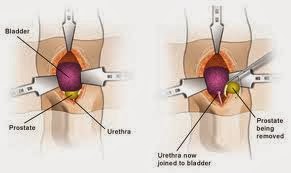
Surgery: Surgery is an option for men with early (Stage I or II) prostate cancer. It's sometimes an option for men with Stage III or IV prostate cancer. Before the surgeon removes the prostate, the lymph nodes in the pelvis may be removed. If prostate cancer cells are found in the lymph nodes, the disease may have spread to other parts of the body. If cancer has spread to the lymph nodes, the surgeon does not always remove the prostate and may suggest other types of treatment. After removing the prostate, the bladder is reconnected to the urethra (tube that men urinate through).

Robotic laparoscopicsurgery: The surgeon removes the entire prostate through small cuts . A laparoscope and a robot are used to help remove the prostate. Instruments are passed through the small cuts and are used to remove the prostate. The surgeon uses handles below a computer display to control the robot's arms.

Open surgery: The surgeon makes a large incision (cut) into your body to remove the tumor. There are two approaches:
  • Through the abdomen: The surgeon removes the entire prostate through a cut in the abdomen. The incision typically is from the umbilicus (belly button) down to the pelvic bone. This is called a radical retropubic prostatectomy.
     
  • Between the scrotum and anus: The surgeon removes the entire prostate through a cut between the scrotum and the anus. This is called a radical perineal prostatectomy.
     

Laparoscopic prostatectomy: The surgeon removes the entire prostate through small cuts , rather than a single long cut in the abdomen. A thin, lighted tube (a laparoscope) helps the surgeon see. Other instruments are passed through the small cuts. These instruments are used to remove the prostate.

TURP: A man with advanced prostate cancer may choose TURP (transurethral resection of the prostate) to relieve symptoms. The surgeon inserts a long, thin scope through the urethra. A cutting tool at the end of the scope removes tissue from the inside of the prostate. 
For more information visit:          http://www.medworldindia.com       
                    
https://www.facebook.com/medworld.india

Please scan and email your medical reports  to us at care@medworldindia.com and we shall get you a Free Medical Opinion from India’s Best Doctors.

Call Us : +91-9811058159
Mail Us : care@medworldindia.com

Thursday, 7 August 2014

Best Treating Options for Prostate Cancer in India : Prostate Cancer Treatment India

Knowing the various treatments for prostate cancer available and what the risks associated with each are is the first step in being informed about what will be one of the most important decisions of your life. The potential side effects of some of the treatments are too life altering to leave this decision to chance.


Have a discussion with your doctor. Ask questions about any side effects you need to be aware of. While your treatment options become less viable if your cancer has progressed beyond your prostate gland, it is important to be aware of what to expect after the treatment has been completed.

Here are some of the options open to you.

Patient Testimonial


Surgery

Surgical options available are as follows.
A complete prostatectomy where your entire prostate gland is removed     A lymph node dissection where only the nodes surrounding the urethra are removed     A transurethral resection is done in which small pieces of your prostate are removed

Each of the above procedures requires a hospital stay and you would be anesthetized and put under. They are effective in most cases although cancers have been known to return weeks or months afterward. As well, side effects can include urinary incontinence, impotence and infertility.

Radiotherapy

There are 2 common approaches to radiation therapy in treating prostate cancer, external beam radiotherapy and brachytherapy.

External beam radiotherapy is a procedure where a high energy radioactive source is used to project a beam at your prostate from a short distance outside your pelvic area. There is no anesthesia required and it is done on an out-patient basis. It is typically done on 5 consecutive days over a period of about 5 to 7 weeks.

Brachytherapy is the usage of about 100 to 150 small radioactive pellets or seeds. They are placed directly into your prostate with a syringe a few at a time; it usually takes up to 40 injections to implant them all. This procedure is painful and requires a general anesthetic.

These two procedures use radioactivity to burn away cancerous cells. Side effects include impotence, inflammation of the bladder and rectum and cancers have been known to return.

Chemotherapy

Drugs known to be toxic to cancerous cells are introduced to your body. It is used to slow cancerous growths and relieve pain. It is not a cure but it can be used to help patients where cures through other means are not possible.


High Intensity Focused Ultrasound (HIFU)

HIFU is a procedure that uses sound waves to destroy cancerous cells. A focused ultrasound beam is aimed only at the regions of the prostate that are diseased with cancer. The cells targeted are destroyed using heat. Surrounding tissue is not affected by the beam and remains undamaged.
The entire prostate can be exposed to the ultrasound beam in about three hours. The procedure is done quickly and is effective in eradicating prostate cancer in over 90% of patients treated. Side effects are minimal resulting in urinary incontinence in only 5% of patients. Only 8% suffered urethral blockage and about 40% suffered sexual impotence. Impotence drops to 20% in patients whose cancer does not affect the prostate nerve.

These reasons alone make HIFU the choice you should make when thinking about prostate cancer treatment options.


For more information visit:          http://www.medworldindia.com       
                    
https://www.facebook.com/medworld.india

Please scan and email your medical reports  to us at care@medworldindia.com and we shall get you a Free Medical Opinion from India’s Best Doctors.

Call Us : +91-9811058159
Mail Us : care@medworldindia.com

Monday, 10 February 2014

Prostate Enlargement, Prostate Problem - Prostatectomy Surgery Options in India


Prostatectomy is surgical removal of a man's prostate gland. It is one possible treatment for prostate cancer and other prostate conditions, such as an enlarged prostate. The operation is performed by a urologist (urologic surgeon) in either open or laparoscopic surgery .

Radical prostatectomy, which includes removal of tissues near the gland, usually cures prostate cancer if the surgery removes all the malignant cells. The incision is usually made through the lower abdomen (retropubic) but also can be made in the groin (perineal). Typically, general anesthesia is used and the patient remains in the hospital for two to four days following surgery. Full recovery may require one month or more.

Partial prostatectomy
is generally a treatment for enlargement of the prostate, which is common after age 50. It can also be used to reduce pain and ease urination in men with advanced prostate cancer.

Complications from prostatectomy are those associated with any surgery, including infection and bleeding. Other complications vary depending on the age and health of the man, type of surgery and experience of the surgeon. Two primary concerns men have about radical prostatectomy are the possibilities of impotence and incontinence. Patients can retain sexual function if nerves are not injured during the surgery. Urinary incontinence is usually temporary but bladder problems can continue for years. Radical prostatectomy does cause sterility, but there are procedures that may allow a man to father children, if desired.

Procedure

Before the procedure the bladder and urethra may be numbed (local anesthesia), body below the waist may be numbed (regional anesthesia), or the patient may be completely asleep (general anesthesia). The procedure itself usually takes about 45 minutes. The doctor inserts a cystoscope (a thin, tubelike telescope) through the urethral opening in the penis and into the urethra. The doctor can view the urethra and prostate, either through the cystoscope or on a video monitor. The laser is inserted through the cystoscope to the area of the prostate. The laser is then used to destroy excess prostate tissue.

Following prostatectomy will vary depending on the type of surgery performed: -

  • Radical prostatectomy (retropubic or perineal) : - This surgery may require the patient to stay hospitalized for two or three days and miss work for three to five weeks. The catheter may remain for one to three weeks. When the patient urinates, the fluid flows through the plastic tube and collects in a bag for disposal.
  • Laparoscopic prostatectomy : - Long-term experience with laparoscopic prostatectomy is not yet available. This surgery may require a hospital stay of only one day. Some physicians and patients report that it involves fewer complications, less pain and faster recovery than open surgery.

  • Partial (simple) prostatectomy (transurethral resection of the prostate [TURP] or transurethral incision of the prostate [TUIP]) : - Generally, a patient is discharged from the hospital after a day or two and can return to work in a week or two. A catheter placed through the urethra is used for a few days to drain urine from the bladder. TUIP does not always require a hospital stay.
For more information visit:          http://www.medworldindia.com        
                    
https://www.facebook.com/medworld.india

Please scan and email your medical reports  to us at care@medworldindia.com and we shall get you a Free Medical Opinion from India’s Best Doctors.

Call Us : +91-9811058159
Mail Us : care@medworldindia.com


Friday, 17 January 2014

Prostate cancer is the Most common cancer found in Men

Prostate cancer is the most common cancer found in men, and the second leading cause of men's cancer deaths. Given those rates, it would seem like a screening test that can catch the disease early would be a major boon to medical care.  However, it hasn't been that simple.

The PSA test is a blood test that looks for a specific protein that is only produced by the prostate. The higher the levels of PSA, the more likely the person has prostate cancer.  If someone is found to have an elevated level, they are often recommended to have a biopsy taken from their prostate. This involves inserting 12 needles into the prostate using an ultrasound and taking a random sampling of tissue.  It seemed as though it would be the answer to help us identify earlier cancers .Before the PSA test, being diagnosed with prostate cancer was almost a death sentence. Now, 16 percent of men are diagnosed, but only 3 percent succumb to the disease.

The problem is that the majority of tumors are not significant enough to warrant treatment. One study suggested that 40 percent of men who receive a positive test result have a cancer too slow-growing to be deadly. The biopsies, radiation, surgery and other treatments can cause serious side effects, including impotence, incontinence and other complications -- even death.

Unlike pancreatic cancer or lung cancer, as the statistics show, many of these [prostate] cancers are not significant. They would be best not diagnosed. Previously, men over the age of 75 were advised not to get the test.

However, some experts believe that the PSA test should still play a role. Without using the blood test, the only method left to check for prostate cancers is a digital rectal exam, when a doctor checks the prostate through the rectum using his or her fingers. Some tumors can be felt, but not others, and they are often discovered too late.

Doctors need to is “screen smarter.” He suggested still using the PSA test and then repeating it to reconfirm if a high PSA score is detected. Doctors could use an advanced MRI scan to try and locate the tumor, rather than going in blindly for a biopsy.

In some cases, a man might not need a biopsy unless their PSA scores keep increasing or they have significant family history. In other instances, the MRI could help guide doctors to get more accurate biopsies. The goal, he explained, is to “identify those cancers that need to be diagnosed and need to be treated as opposed to all of those insignificant cancers that the current way we are doing things is leading to.

Minimally Invasive Laser Prostate Surgery for Prostate Cancer Green Light Laser PVP :

Green Light Laser Therapy is a minimally invasive treatment option that combines the effectiveness of the traditional surgical procedure known as transurethral resection of the prostate (TURP). The GreenLight laser system delivers the ultimate BPH solution GreenLight is suitable for most patients with an enlarged prostate, the GreenLight procedure is creating a new standard of care — a standard that offers freedom from enlarged prostate / Prostate cancer symptoms .Most patients return home a few short hours after the GreenLight procedure and can return to normal, non-strenuous activities within days. The advantages of this approach over the traditional TURP (transurethral resection of the prostate) are many: Rapid urine flow improvement,Quick return to normal activities ,Virtually bloodless procedure , Outpatient procedure in otherwise healthy patients.

 
  • Radiotherapy :Radiotherapy uses high energy waves to treat cancer. If your cancer has not spread beyond the prostate gland you can have radiotherapy to try to cure it. This is called radical radiotherapy. This type of treatment involves giving a high dose of radiation to the prostate gland.

  • Chemotherapy :Chemotherapy is the use of drugs to cure or control cancer. Chemotherapy may be used if your cancer has spread beyond the prostate and is no longer controlled by hormone therapy. In some cases, chemotherapy will improve your quality of life with better control of your symptoms.

For more information visit:          http://www.medworldindia.com        
                    
https://www.facebook.com/medworld.india

Please scan and email your medical reports  to us at care@medworldindia.com and we shall get you a Free Medical Opinion from India’s Best Doctors.

Call Us : +91-9811058159
Mail Us : care@medworldindia.com